


When the flag doesn't hold
5/6/25
By:
Michael K.
Five Countries, One Fault Line: A Chronicle of European Fatigue as of May 6, 2025
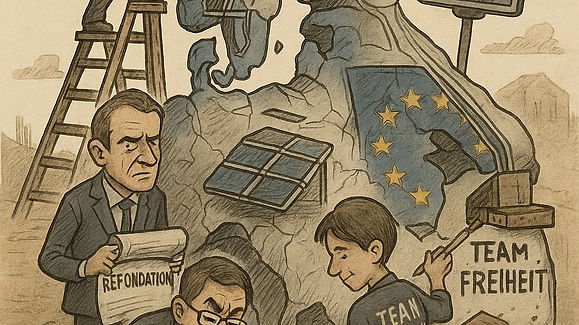
“Fatigue,” said the interlocutor, squinting at the headline, “isn’t when you can’t run anymore. It’s when you no longer believe it’s worth it.”
⸻
Poland: A flag underfoot, a shadow backstage
Sometimes, symbolism crosses a line — and then it becomes politics. In the Polish Sejm, MP Grzegorz Braun, a presidential candidate from the ultra-conservative Confederation party, walked up to the podium, tore down the flag of the European Union, and flung it aside. No preamble, no justification. Just a phrase: “Let it disappear at last.”
The chamber erupted. The Sejm’s speaker demanded Braun stop the provocation. Opposition MPs condemned it as an anti-state gesture. The media saw a typical case of playing the eurosceptic card in the run-up to elections. But this act, carried out in the very heart of legislative authority, felt especially charged — as though Braun was deliberately ripping apart the fabric that binds Poland to Europe.
Meanwhile, outside the chamber, came a statement of far more concrete weight. Prime Minister Donald Tusk, speaking to Warsaw residents, declared that Russia was interfering in the Polish presidential campaign. He offered no documents, no classified briefings — only a firm warning: “Russia is interfering in our elections. We have evidence of this.”
Tusk referred to cyberattacks, disinformation campaigns, and attempts to sway public opinion through social media. As Poland prepares for the first round of elections on May 18, his words signal that the ballot box is no longer merely an arena for populism — but the target of a hybrid war.
“It’s not just a flag that fell,” said the interlocutor. “It’s the illusion that elections are a domestic affair.”
⸻
Spain: An Argentine echo and a Catalan shout
Far from Europe — but hitting its nervous system — came a voice. Argentine President Javier Milei again lashed out at Spain’s government, branding it a “socialist dictatorship” and “enemy of freedom.” His remarks came not in private circles but through media interviews, public speeches, and social media.
Spain’s response was calm, but pointed. Prime Minister Pedro Sánchez denounced Milei’s comments as an unacceptable attack on a democratic government, and stated that Madrid expected clarifications from Buenos Aires.
What seemed like standard diplomatic friction revealed a deeper fatigue — not anger, but exhaustion. A sense that even ideological allies now feel free to speak in ways that once crossed every line of civility.
Meanwhile, in Barcelona’s historic center, citizens protested the invasion of mass tourism. “Barcelona is not for sale,” their signs read. Locals, especially in the Gothic Quarter and Raval, decried rising rents, noise, displacement, and the erosion of their city’s soul.
This wasn’t just about housing. It was about reclaiming identity. When a city turns into a postcard, even those born there can feel like tourists.
⸻
France: Democracy as a Draft
“If a government needs to reboot democracy,” said the interlocutor, flipping through the news, “it probably means something has frozen.”
There’s no shouting in France, no flag-ripping or diplomatic crossfire. But the atmosphere is just as heavy. President Emmanuel Macron recently spoke of the need for a “democratic refoundation” — refondation démocratique.
He made the statement against the backdrop of dire polling numbers: trust in political institutions is at a historic low, and Marine Le Pen’s far-right party is leading ahead of the European Parliament elections.
Macron is no stranger to grand rhetoric. But this time, his words didn’t feel like a rallying cry. They sounded like an admission. Not of defeat, but of decay. A confession that the system is no longer convincing anyone — not even those running it.
While Macron dreams of reform, France’s teachers are marching in the streets. The cause? A controversial reform of vocational education, which unions denounce as a top-down maneuver that ignores both teachers and students. The Education Ministry insists it will improve efficiency and align with the job market. Teachers reply: you never asked us, nor the kids. What they see is a bureaucratic erosion of pedagogy in favor of corporate logic.
And while politics stalls, technology sails ahead. In the Var department, France launched its first large-scale floating solar power plant — a milestone in renewable energy, quietly floating on water as debate rages on land.
“France is like an old dirigible,” the interlocutor murmured. “It flies — until it remembers where it’s supposed to go.”
⸻
Germany: A Second Round, a First Doubt
Friedrich Merz became chancellor — but not right away.
In the first round of Bundestag voting, he failed to secure the required majority, despite having a formal coalition. The political press called it an embarrassment; insiders whispered of fractures inside his own alliance. Germany, famously cautious, had just stumbled on step one.
He was confirmed in the second round. But the damage was done. Merz spoke of responsibility, modernization, and a clear path forward. But all anyone could talk about was his stuttering start.
As if on cue, Frauke Petry, former AfD leader, announced the creation of a new party: Team Freiheit — “Team Freedom.” Branded as a platform for free speech, low taxes, and an end to ideological migration policies, it positions itself as a democratic alternative to the hard right. But in truth, it’s another iteration of the same populist pressure.
Meanwhile, Thorsten Frei, the new head of the Federal Chancellery, took a much firmer line: he called for systematic border control and direct deportations at Germany’s borders with Poland, Austria, and the Czech Republic.
“We have the legal tools,” he said. “Now we need the will to use them.”
His proposal includes not only enhanced monitoring but immediate rejection of asylum seekers with no legal basis, even before they enter processing. It’s no longer just policy. It’s a redrawing of Europe’s interior lines — by Europeans themselves.
⸻
Netherlands: Gasoline, Borders, and Death
In the Netherlands, the headlines are quieter — but no less telling.
Fuel prices are dropping, a rare event after months of economic tension. Analysts link the decline directly to new trade moves by Donald Trump’s U.S. administration, which slapped fresh tariffs on Chinese oil products. Less global competition has meant lower prices in Dutch markets — proof that you vote in The Hague, but you pay at the pump in Washington.
But the more profound conversation isn’t about gasoline. It’s about death.
Dutch legal and medical experts are calling for a revision of how the state defines “natural death.” The current system treats any death without violence or external trauma as “natural.” But doctors say this no longer reflects reality — especially in cases involving chronic illness, multiple medications, or assisted dying.
They’re proposing a third category: “combined death.” A space between natural and unnatural — where medical, social, and ethical factors converge. It’s not a semantic adjustment. It’s an attempt to update a 19th-century legal framework to match 21st-century moral complexity.
“Have you noticed,” the interlocutor said, “that even death in Europe has become something to be reinterpreted? Not because someone died — but because meaning is gone.”
Latest news